Most content creators assume that the answer to more traffic is simple: publish more.
While creating fresh content certainly has its place, it’s easy to overlook something much closer to home — your existing articles.
If you’ve built up a library of blog posts over months or years, there’s a good chance some of them could perform better with a handful of targeted improvements. The challenge is knowing where to start.
That’s where a focused review can be far more valuable than another blank page.
In this article, we’ll look at why improving existing content is often worth your time, what to look for when reviewing an article, and how a tool like Traffic Leak Finder can simplify the process.
Why Existing Content Often Has Untapped Potential
Publishing a blog post isn’t really the end of the writing process.
It’s the beginning.
As your writing improves, your understanding of your audience grows, and search behaviour changes over time, older articles can begin to show their age.
Perhaps the title no longer reflects the article’s strongest benefit.
Maybe important questions are left unanswered.
Perhaps the introduction takes too long to reach the point.
Or maybe the article simply isn’t as easy to follow as it could be.
None of these problems necessarily requires a complete rewrite.
Often, a series of thoughtful improvements can strengthen an article considerably.
Why It’s Difficult to Know What Needs Improving
The biggest challenge isn’t editing.
It’s diagnosis.
When you’ve written an article yourself, you’re already familiar with it.
That familiarity makes it surprisingly difficult to spot missing information, weak transitions, repetitive sections, or structural problems.
It’s similar to proofreading your own work — you often read what you intended to write rather than what actually appears on the page.
That’s why an objective review is valuable.
Not because it replaces your judgment, but because it highlights areas you may no longer notice.
Common Traffic Leaks Hidden Inside Articles
Many articles suffer from small issues that quietly reduce their effectiveness.
Some of the most common include:
Weak Titles
A title should clearly communicate the article’s main benefit.
If it’s vague or overly clever, readers — and search engines — may struggle to understand what the page offers.
Slow Introductions
Readers usually want reassurance that they’ve found the right page.
If several paragraphs pass before the main topic appears, engagement may suffer.
Missing Questions
Imagine someone searches for information on a topic.
Your article answers five questions.
They expected answers to seven.
Those missing sections can reduce the overall usefulness of the content.
Poor Heading Structure
Good headings help readers scan an article.
They also make the structure clearer.
Large blocks of text without meaningful headings can make useful content feel difficult to read.
Repetition
Sometimes articles explain the same point in multiple ways.
Removing repetition often improves readability while making the article feel stronger.
Weak Conclusions
A conclusion should leave readers with clarity.
Many articles simply stop.
Adding a stronger closing section can improve the overall experience.
Why Generic SEO Checklists Aren’t Enough
Search online for SEO advice and you’ll find endless checklists.
They’re useful…
…but they’re also generic.
A checklist doesn’t know what’s inside your article.
It can’t tell you whether your introduction is too slow, whether you’ve answered the obvious questions, or whether one section feels much weaker than the others.
That’s why article-specific feedback is far more actionable.
Instead of ticking boxes, you’re improving the content that’s actually in front of you.
A Simpler Way to Review Articles
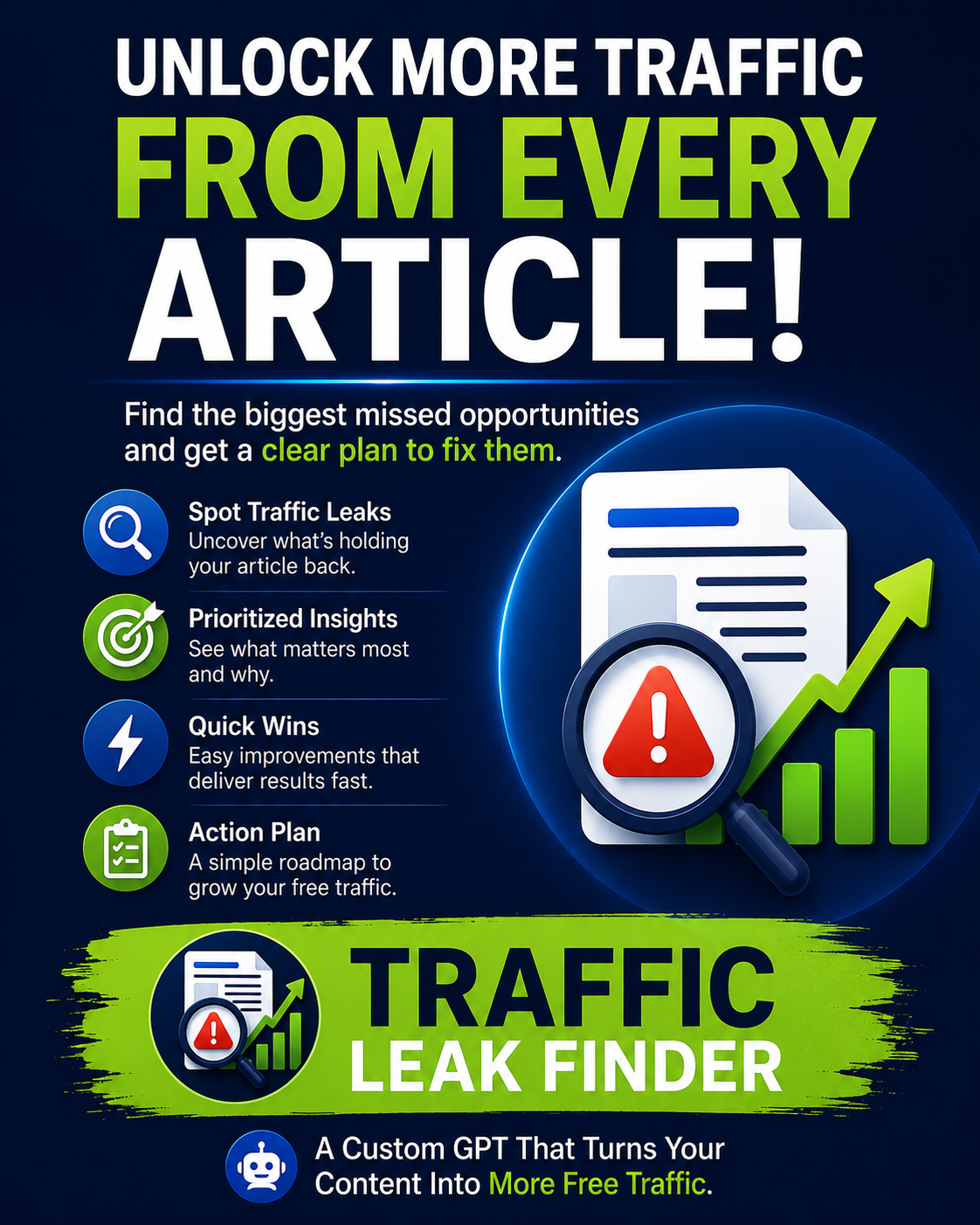
This is exactly what Traffic Leak Finder was designed to do.
Instead of asking you to learn technical SEO or work through complicated reports, it focuses on one article at a time.
You simply paste the full text (and the title/subtitle if you have them) into the Custom GPT.
It then reviews the article and identifies the biggest missed opportunities for attracting more free organic traffic.
Rather than overwhelming you with dozens of tiny suggestions, it prioritizes the improvements that are likely to have the greatest impact.
That makes it much easier to decide what to work on first.
What Traffic Leak Finder Looks For
Traffic Leak Finder reviews your article from a practical content perspective.
Among other things, it evaluates:
* The clarity and effectiveness of your title.
* Whether the article appears to match likely reader intent.
* Heading structure.
* Topic coverage.
* Questions readers may still have.
* Thin or repetitive sections.
* The strength of the introduction.
* The effectiveness of the conclusion.
* Readability.
* General opportunities to encourage readers to continue exploring your content.
Importantly, it bases its recommendations on the article you provide.
It doesn’t invent analytics, rankings, competitors, or keyword research.
Its goal is to help you improve the content that’s already there.
Practical Use Cases
Before Publishing
You’ve finished writing a new article.
Before clicking Publish, you run it through Traffic Leak Finder.
It identifies several quick improvements that make the article clearer and more complete.
Updating Older Content
You have articles that are two or three years old.
Rather than rewriting them completely, you review each one and focus on the highest-priority improvements first.
Refreshing Evergreen Content
Some articles remain useful for years.
An occasional review helps ensure the structure, clarity, and reader experience remain strong.
Creating a Better Editing Workflow
Instead of relying on memory or generic checklists, every article receives the same structured review.
That makes your editing process more consistent.
Why One Article at a Time Works
Many SEO tools try to do everything.
Traffic Leak Finder intentionally does much less.
It focuses on one article.
That narrow focus has advantages.
You don’t need to fill in forms.
You don’t need analytics.
You don’t need keyword reports.
You simply provide one article and receive a clear, prioritized review.
That keeps the process fast and manageable.
Small Improvements Add Up
Content improvement doesn’t always require dramatic changes.
A stronger title.
A clearer introduction.
Better headings.
Answering one additional reader question.
Removing unnecessary repetition.
Each improvement may seem small on its own, but together they can make an article more useful, more engaging, and easier to understand.
That’s often a far better investment than constantly starting over with brand-new content.
Final Thoughts
If you’re creating articles regularly, it’s worth remembering that your existing content may contain opportunities you’ve simply overlooked.
A focused review can help you identify those opportunities without drowning you in technical SEO advice or endless reports.
Traffic Leak Finder was built for exactly that purpose.
Paste in one article, receive a prioritized list of improvements, and work through the recommendations one step at a time.
Sometimes your next traffic win isn’t your next article.
It’s your last one—improved.
Try Traffic Leak Finder
If you want a simple way to uncover the biggest missed opportunities in your existing articles, give Traffic Leak Finder a try.
Paste in one blog post or article, review the recommendations, and use the prioritized action plan to strengthen your content before moving on to the next piece.